Why does true yeast culture work in ruminants?
In the first article in this series, “What Is a Yeast Culture, Really?”, we discussed that a true yeast culture is not simply a source of Saccharomyces cerevisiae cells or their intracellular components. Its distinguishing feature lies in the preservation of the matrix formed by the biomass, the culture medium and the metabolites produced during fermentation.
But what makes this matrix biologically relevant to ruminants?
The answer lies in the nature of the rumen itself. This compartment functions as a complex microbial ecosystem, in which bacteria, protozoa and fungi interact in the degradation of dietary components (Sanjorjo et al., 2023). The activity of these microorganisms determines how nutrients are directed toward different fermentation products and, consequently, influences the quantity and type of energy made available to the animal.
Structural and non-structural carbohydrates, derived from components such as cellulose, hemicellulose, pectin and starch, are degraded by the ruminal microbiota and converted into sugars and metabolic intermediates. Many of these pathways converge on pyruvate, a central intermediate in microbial metabolism (Reddy & Hyder, 2023). From there, different microbial groups direct carbon toward the formation of acetate, propionate, butyrate and other end products. The proportions of these metabolites are not fixed, they are influenced by diet composition, substrate availability, microbial interactions and the physicochemical conditions of the rumen.
Short-chain fatty acids (SCFAs) represent one of the main sources of energy for ruminants. Acetate is primarily associated with lipid metabolism, propionate plays a central role as a gluconeogenic precursor, and butyrate is extensively utilized by the ruminal epithelium, where it is converted into β-hydroxybutyrate. Thus, fermentation efficiency depends not only on SCFA production, but also on how substrates are directed among the different metabolic pathways.
An example of this interaction involves lactate. In diets with a high proportion of rapidly fermentable carbohydrates, its production may increase, making the balance between its production and utilization particularly important. In this context, microorganisms such as Megasphaera elsdenii play a relevant role by utilizing lactate and converting it into SCFAs, including propionate and butyrate (Cabral & Weimer, 2024). In the acrylate pathway, for example, lactate is converted into propionate, linking lactate metabolism to the redox balance of ruminal fermentation.
Efficient lactate utilization can reduce its accumulation and contribute to the stability of the ruminal environment. Studies involving yeast supplementation also reported stimulation of lactate-utilizing microbial groups and changes in fermentation conditions (Baker et al., 2022). This phenomenon highlights a fundamental characteristic of the rumen: microorganisms do not act in isolation. The metabolic product of one population can become a substrate for another, establishing a complex network of metabolic interdependence.
It is precisely within this network that yeast culture metabolites can exert their effects. Cultron® is an S. cerevisiae culture obtained through controlled fermentation. During this process, the yeast utilizes the available nutrients and continuously modifies the culture medium, producing and accumulating different metabolic compounds.
Preserving this matrix ensures that the final product contains not only the yeast biomass, but also the chemical and biological outcome of the fermentation process.
What do we observe in Cultron®?
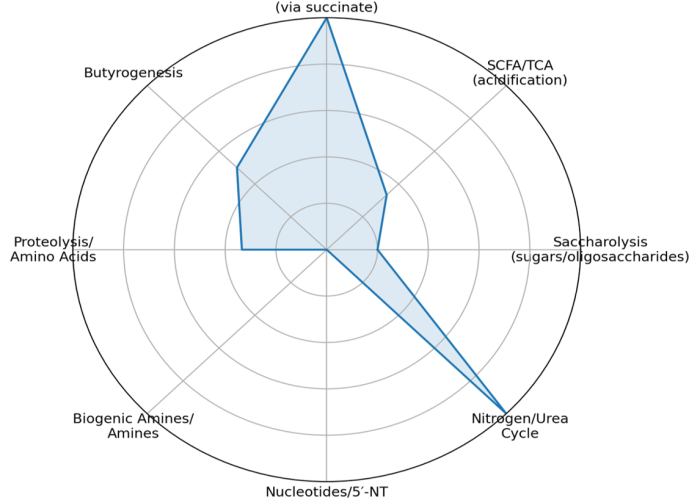
The metabolomic characterization of Cultron® demonstrates this complexity. Thousands of chemical features were identified and, in a targeted analysis, biologically relevant metabolites were evaluated. The profile of Cultron® proved distinct from those of other yeast-derived technologies , demonstrating that products of the same origin may present different metabolic compositions. Among the compounds that stood out were glycerol, glucose, sucrose, glucose-6-phosphate, maltose and glucuronate, which are related to different pathways of energy metabolism and fermentation.
Rather than focusing on isolated compounds, this approach makes it possible to characterize the overall fermentation matrix and explore its potential functions in the ruminal environment. The distribution and relative abundance of different metabolite groups can be visualized in the functional metabolic profile radar chart (Figure 1) , which represents a metabolic signature of the product.
This perspective helps demonstrate that the functionality of the matrix results from interactions among different groups of metabolites rather than from the action of a single molecule.
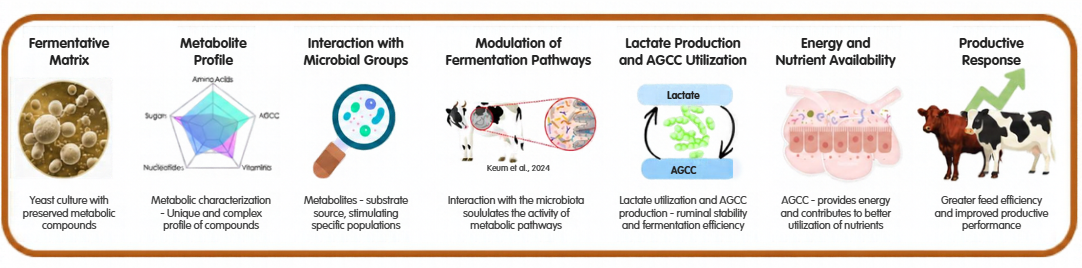
This characteristic is particularly relevant when considering the ruminal environment. The metabolites present in the culture do not act in isolation; they may interact with different microbial populations, influencing their activities and, consequently, the direction of fermentation pathways. In the case of Cultron®, the metabolomic characterization indicates associations with pathways related to energy metabolism and propionate formation, as well as bacterial groups involved in lactate utilization, such as Megasphaera elsdenii and Selenomonas ruminantium, and microorganisms related to the degradation of fibrous components.
Thus, the functional metabolic profile helps establish a connection between the matrix produced during fermentation, the microbial groups present in the rumen and the metabolic pathways involved in ruminal fermentation (Figure 2).
This relationship helps explain the potential of a yeast culture to modulate the ruminal environment. However, it is important to emphasize that metabolomics identifies differences in chemical profiles and possible associations with metabolic pathways and microbial groups. Confirming these mechanisms requires an integrated approach combining fermentation assays, microbiota studies and zootechnical evaluations.
The connection between metabolites, microbiota and fermentation helps us understand how a yeast culture can act on the ruminal environment and contribute to more efficient nutrient utilization. But understanding the mechanism is only part of the evaluation of nutritional technology. The next question is: do these mechanisms translate into consistent responses in animals? In the next article, we will explore this question by examining the consistency of the responses obtained with Cultron® under different production conditions.
References
Baker, L. M., Kraft, J., Karnezos, T. P., & Greenwood, S. L. (2022). Review: The effects of dietary yeast and yeast-derived extracts on rumen microbiota and their function. Animal Feed Science and Technology, 294, 115476.
Cabral, L. D. S., & Weimer, P. J. (2024). Megasphaera elsdenii: its role in ruminant nutrition and its potential industrial application for organic acid biosynthesis. Microorganisms, 12(1), 219.
Keum, G. B., Pandey, S., Kim, E. S., Doo, H., Kwak, J., Ryu, S., … & Kim, H. B. (2024). Understanding the diversity and roles of the ruminal microbiome. Journal of Microbiology, 62(3), 217–230.
Reddy, P. R. K., & Hyder, I. (2023). Ruminant digestion. Textbook of Veterinary Physiology, 353–366.
Sanjorjo, R. A., Tseten, T., Kang, M. K., Kwon, M., & Kim, S. W. (2023). In pursuit of understanding the rumen microbiome. Fermentation, 9(2), 114.
Author